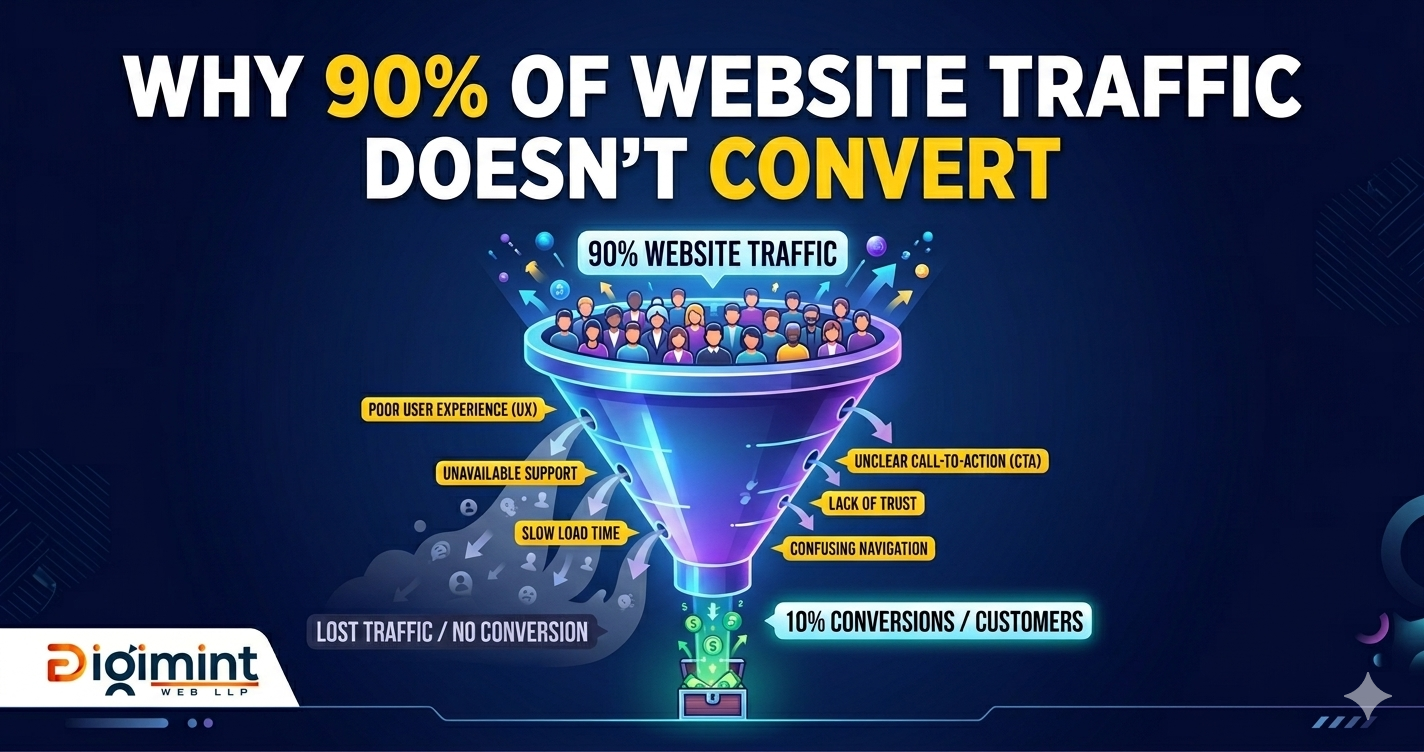
You’re spending on traffic. Visitors are arriving. But nobody’s converting. Here’s exactly why — and how to fix it.
96%
of website visitors leave without acting
2.35%
average website conversion rate
3 sec
before a slow site loses the visitor
75%
judge credibility by website design
You launched a website. You invested in design. You may even be running Google Ads or posting on social media regularly. But at the end of the month, you open your CRM and stare at an empty pipeline. Your website is not generating leads — and you don’t know why.
You’re not alone. Thousands of businesses across India and globally face the exact same problem. Their websites get traffic, but that traffic evaporates without leaving behind a name, an email, or a phone number. This is one of the most frustrating and costly problems in digital marketing today.
In this guide, we’ll break down the real reasons your website is failing to capture leads and give you actionable, proven fixes to turn things around in 2026.
Your Value Proposition Is Unclear
Within 5 seconds of landing on your homepage, a visitor should understand: What do you do? Who is it for? Why should I choose you? If your headline is vague, generic, or tries to sound too clever, your visitor simply won’t know what to do next.
Fix: Write a crystal-clear headline that speaks directly to your ideal customer’s pain point. For example: “We build conversion-optimised websites for Indian SMEs that want more leads, not just more traffic.” Specificity sells.
No Clear Call-to-Action (CTA)
This is one of the biggest reasons websites fail to convert visitors into leads. If every page on your website ends without a clear next step — a button, a form, a phone number — your visitors will leave quietly. Decision fatigue is real; people need to be told what to do.
Fix: Every page must have one primary CTA above the fold. Use action verbs: “Get a Free Audit,” “Book a Call,” “Download the Guide.” Make it visually prominent — contrasting colour, ample white space, and no competing distractions around it.
Key Insight: Websites with a single, focused CTA per page convert up to 266% better than pages cluttered with multiple competing actions. Clarity always beats cleverness.
Slow Page Speed Is Silently Killing Your Lead Generation
If your website takes more than 3 seconds to load, you are losing more than half your potential leads before they even read your first line. Google’s own data shows that a 1-second delay in mobile load time can cut conversions by up to 20%. Speed is not a technical detail — it is a business-critical factor.
Test your website performance using Google PageSpeed Insights and fix the issues it highlights. Compress images, enable browser caching, minimise JavaScript, and consider upgrading to faster hosting. In 2026, a slow website is simply invisible to most users.
Not Mobile-Optimised
Over 70% of all web traffic in India comes from mobile devices. If your website is difficult to navigate on a phone — tiny text, broken layouts, hard-to-tap buttons — you are actively pushing away the majority of your audience. A website that doesn’t work on mobile is not generating leads because it was never built to.
Fix: Test your website on multiple screen sizes. Ensure forms are easy to fill on a phone, buttons are at least 44px touch-targets, and there’s no horizontal scrolling. A mobile-first design approach is non-negotiable in 2026.
Wrong Traffic — Poor SEO Targeting
Your website might be receiving traffic but still not producing leads because you’re attracting the wrong audience. If you rank for broad, informational keywords but your business needs buyers, you’ll get readers, not customers. Many businesses fail at website lead generation simply because their SEO strategy brings in curiosity traffic, not purchase-intent traffic.
Fix: Focus on commercial intent keywords — phrases like “hire web design company in Surat,” “digital marketing agency near me,” or “SEO services for small business.” These visitors are ready to act. Use tools like Google Search Console and SEMrush to identify which keywords are actually driving conversions.
“Traffic without intent is just noise.”
The goal is not to attract everyone — it’s to attract the right people at the right stage of their buying journey. A website built to generate leads filters for quality, not just quantity.
No Trust Signals or Social Proof
Visitors who find your website for the first time have one key question: “Can I trust these people?“ If your website lacks client logos, testimonials, case studies, or reviews, you’re essentially an unknown brand asking visitors to trust you with their contact information. Your site’s inability to collect leads may come down entirely to a credibility gap.
Fix: Add real client testimonials with photos and names. Showcase past projects. Feature any media mentions, certifications, or awards. Display your Google rating if it’s strong. Even a simple “Trusted by 200+ businesses” counter adds reassurance.
Your Landing Pages Are Too Generic
If you’re running Google Ads or social media campaigns but sending all traffic to your homepage, you are wasting your budget and losing leads. A generic homepage speaks to everyone — and therefore converts no one. Dedicated landing pages are what separate websites that fail at lead generation from those that thrive.
Fix: Create specific landing pages for each service, campaign, or audience segment. Match the message of your ad to the headline of the landing page. Remove navigation menus from landing pages — keep the visitor’s attention on the single action you want them to take.
Lead Capture Forms Are Too Complicated
Asking for too much information too soon is a conversion killer. If your contact form has 10 fields — company name, budget range, how did you hear about us, message, phone, email, city, etc. — most visitors will abandon it. Form friction is a primary reason websites struggle with lead generation.
Fix: Reduce your primary form to just 2–3 fields: Name, Email, and one qualifying question. You can gather more information during follow-up. A/B test shorter forms vs. longer ones — in most industries, shorter wins every time.
What a Lead-Killing Website Looks Like vs. a Lead-Generating One
| Element | ❌ Not Generating Leads | ✅ Generating Leads |
| Homepage Headline | Vague, generic tagline | Clear value proposition |
| CTA Placement | Buried at bottom | Prominent above the fold |
| Page Load Time | 5+ seconds | Under 2.5 seconds |
| Mobile Experience | Desktop-only design | Mobile-first responsive |
| Contact Form | 10+ fields, complex | 2–3 fields, simple |
| Social Proof | No testimonials/reviews | Reviews, logos, case studies |
| SEO Targeting | Broad informational keywords | Commercial intent keywords |
| Lead Magnet | Nothing to offer for free | Free audit, guide, or demo |
You Have No Lead Magnets or Offers
Most people who visit your website aren’t ready to make a purchase the first time they land on it. They are researching, comparing, evaluating. If your only offer is “Contact Us,” you lose everyone who isn’t ready. This is a major reason websites fail to capture leads — there’s nothing compelling enough to exchange a visitor’s email address for.
Fix: Create a valuable free offer: a free website audit, a downloadable checklist, a free consultation, a case study PDF, or a short video training. Position it clearly: “Get Your Free Website Lead Generation Audit — Worth ₹5,000.”The perceived value dramatically improves opt-in rates.
You’re Not Retargeting Visitors Who Leave
Even a well-optimised website won’t convert every visitor the first time. Studies show that it takes an average of 7–12 touchpoints before a B2B prospect makes a decision. If you’re not running retargeting campaigns through Google or Meta, you’re letting warm leads — people who already know you exist — slip through your fingers forever.
Fix: Install Facebook Pixel and Google Tag Manager on your website today. Set up retargeting audiences for visitors who spent more than 30 seconds on key pages. Serve tailored ads to users based on the pages they’ve already visited. This alone can dramatically improve your website’s ability to generate leads without increasing ad spend.
Your 2026 Website Lead Generation Action Plan
Now that you know why your website is not generating leads, here is a prioritised checklist to fix it systematically. Work through this list over the next 30 days and you will see measurable improvement in your lead pipeline.
- Rewrite your homepage headline to clearly state your value proposition
- Add a single, prominent CTA above the fold on every key page
- Run PageSpeed Insights and fix your top 3 speed issues
- Test your website on 3 different mobile devices
- Conduct a keyword gap analysis — target commercial intent searches
- Add at least 5 real testimonials with photos to your homepage
- Create dedicated landing pages for your top 3 services
- Reduce your contact form to 3 fields only
- Launch one lead magnet (free audit, guide, or consultation)
- Set up Google and Meta retargeting pixels today
- Install Google Analytics 4 + set up conversion goal tracking
- A/B test your CTA button text and colour over 30 days
Pro Tip from DigiMint Web: Don’t try to fix everything at once. Pick the top 3 issues that apply most directly to your current situation. Implement, measure results for 2–3 weeks, then move to the next batch. Systematic improvement beats scattered perfection every time.
Final Thoughts: Your Website Should Be Your Best Salesperson
A website that is not generating leads is not just a missed opportunity — it is a daily cost. Every visitor who leaves without converting is a potential customer who went to your competitor. In 2026, with competition fiercer than ever, a passive website is simply not an option.
The good news? Every single issue covered in this guide is fixable. You don’t need to rebuild your entire website from scratch. Small, strategic improvements — a sharper headline, a faster load time, a simpler form, a compelling free offer — can completely transform your website’s ability to generate leads.
At DigiMint Web, we specialise in building and optimising websites that do exactly one thing exceptionally well: turn visitors into leads, and leads into customers. If you’d like us to take a look at your website and tell you exactly what’s holding back your lead generation, we’re offering a free audit to every business that reaches out this month.