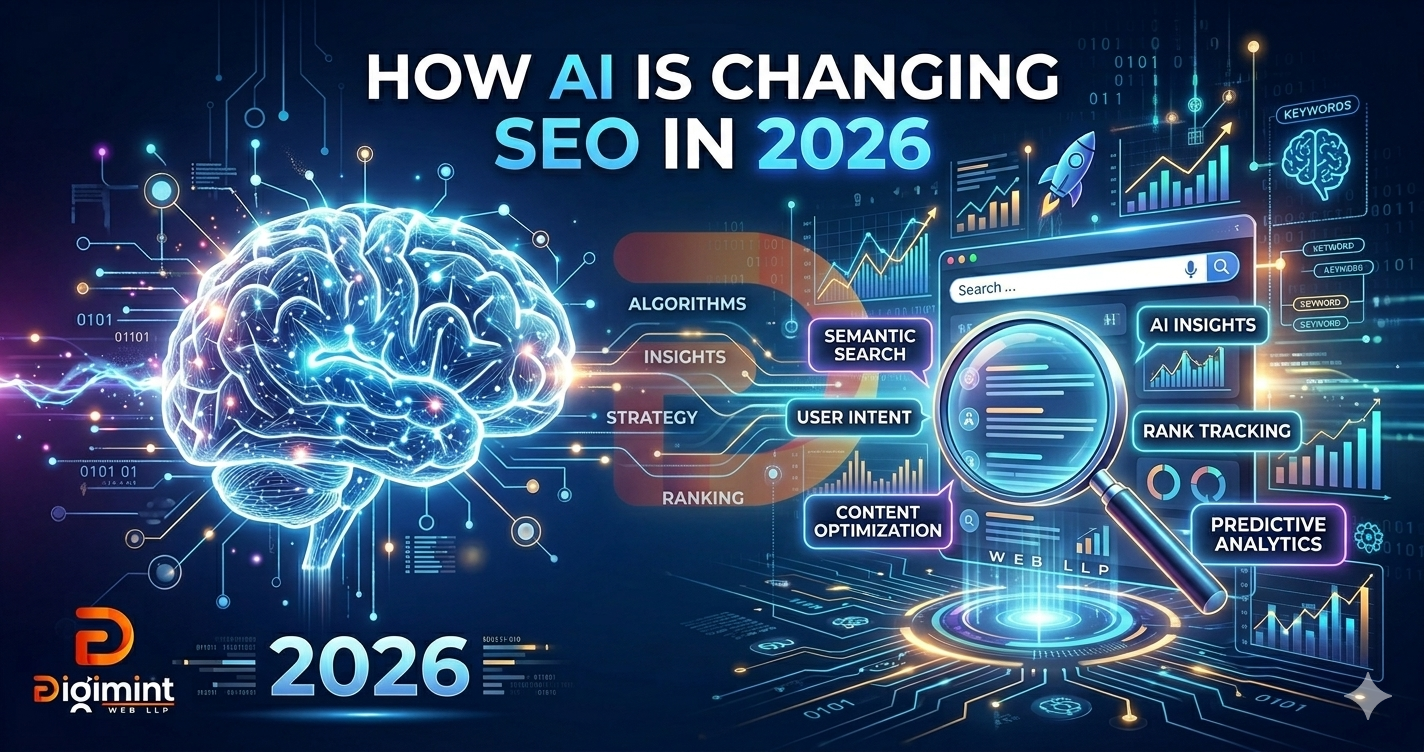
The Search Landscape Has Changed — Have You?
There was a time when ranking #1 on Google meant you dominated the internet. You stuffed the right keywords in the right places, built a few backlinks, and watched the traffic roll in. That playbook worked for over two decades.
But 2026 looks very different.
Today, when someone searches “best digital marketing agency in Surat,” they might not see ten blue links. Instead, an AI-generated answer synthesises the top sources, delivers a curated response — and your website may never be clicked, even if you rank perfectly.
This is the core tension driving the biggest debate in digital marketing right now: SEO vs GEO — what actually works in 2026?
In this deep-dive guide, we break down both strategies, explore how search engine optimisation and generative engine optimisation differ, and reveal why the smartest brands are not choosing sides — they are combining both.
What Is Traditional SEO (Search Engine Optimisation)?
Search Engine Optimisation (SEO) is the discipline of improving your website’s visibility in organic search results on platforms like Google and Bing. It has been the cornerstone of digital marketing since the late 1990s.
The classic SEO formula involves three pillars:
- On-Page SEO — Keyword research, meta tags, heading structure, content quality, and internal linking.
- Off-Page SEO — Backlink building, domain authority, and digital PR.
- Technical SEO — Site speed, mobile responsiveness, crawlability, Core Web Vitals, and schema markup.
When done right, SEO puts your web pages in front of people actively searching for what you offer. It drives high-intent organic traffic, builds credibility, and delivers measurable ROI.
In 2026, traditional SEO still matters enormously. Millions of users still use Google daily for navigational, transactional, and local searches. If someone types “web design services near me,” they want a list of businesses — not an AI essay. For local service businesses, e-commerce stores, and high-intent transactional queries, ranking on the first page of SERPs remains a powerful competitive advantage.
SEO is not dead. But it is evolving.
What Is GEO (Generative Engine Optimisation)?
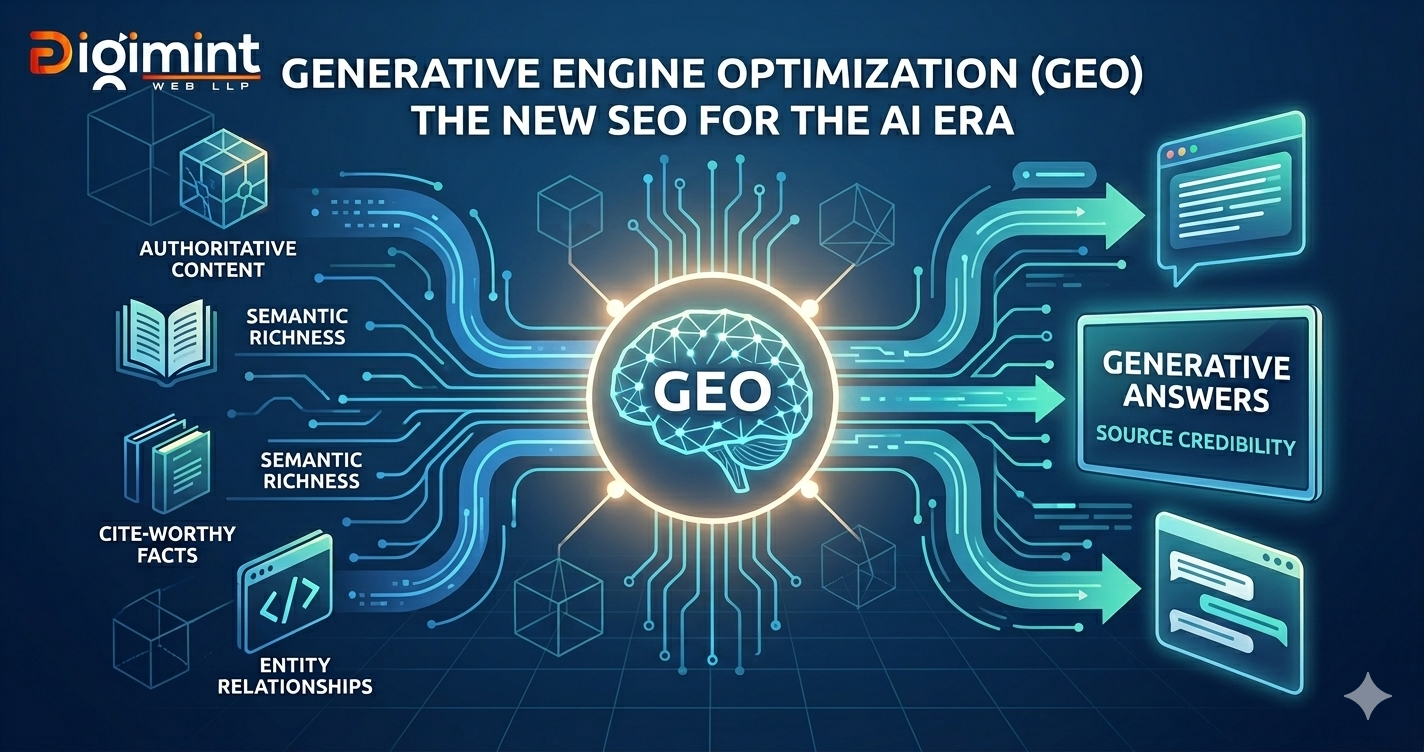
Generative Engine Optimisation (GEO) is the emerging practice of optimising your content and digital presence so that AI-powered platforms — like ChatGPT, Google AI Overviews, Perplexity, and Gemini — cite, quote, recommend, or reference your brand when generating responses to user queries.
Think of it this way:
Traditional SEO is about earning a spot on the shelf in the library of the internet.
GEO is about being the source the librarian reads aloud — except the librarian is now an AI.
Instead of measuring rankings and click-through rates, GEO success is measured by:
- Brand mentions in AI-generated responses
- Citations and direct references to your content
- Share of voice across AI platforms
- Sentiment — how positively AI models describe your brand
GEO is not just a buzzword. According to a 2025 Gartner forecast, <strong>organic search traffic to commercial websites is projected to drop by 25% by the end of 2026</strong> as AI-powered answer engines absorb more information-seeking queries. A BrightEdge study further confirmed that AI Overviews now appear on over 40% of Google search results pages, pushing traditional blue links further down the screen.
And here’s the stat that should stop every marketer in their tracks: fewer than 10% of sources cited by ChatGPT, Gemini, and Copilot rank in the top 10 Google organic results for the same query. In other words, ranking well on Google no longer guarantees you will appear in AI answers.
SEO vs GEO: Head-to-Head Comparison
| Factor | Traditional SEO | Generative Engine Optimisation (GEO) |
| Primary Goal | Rank high in SERPs, earn clicks | Get cited/mentioned in AI responses |
| Target Platforms | Google, Bing, Yahoo | ChatGPT, Gemini, Perplexity, AI Overviews |
| Success Metric | Rankings, traffic, CTR | Mentions, citations, share of AI voice |
| Content Focus | Keywords, relevance, backlinks | Authority, structure, comprehensiveness |
| User Journey | Finds your link, clicks to site | Gets AI answer (you may not get the click) |
| Stability | Relatively stable rankings | Highly variable (40-60% cited sources change monthly) |
| Best For | Transactional, local, navigational queries | Research-heavy, B2B, complex decision queries |
Why GEO Is Not a Replacement for SEO — But an Evolution
One of the most common misconceptions is that GEO will completely replace SEO. This is not the case — and believing so could seriously harm your digital strategy.
Here is the reality: GEO is built on the same foundations as traditional SEO.
AI systems operate within interconnected environments. When ChatGPT, Perplexity, or Google’s AI Overviews generate a response, they pull from the live web. Pages that are technically accessible, have strong authority signals, and contain well-structured, high-quality content are more likely to be crawled, understood, and referenced.
- Well-written, authoritative content performs well in both organic rankings and AI citations.
- Technical SEO (fast load times, mobile optimisation, clean crawlability) helps both traditional search engines and AI bots access your content.
- Backlinks still matter — AI models use live search to find sources, and pages with strong backlink profiles are more likely to rank in the sub-queries AI generates.
The key difference lies in the end goal: traditional SEO optimises for clicks and rankings, while GEO optimises for being the trusted source AI engines choose to reference.
For businesses in India — particularly in cities like Surat, Ahmedabad, and Mumbai — this means you must build content that satisfies both a human reader clicking through to your website AND an AI engine synthesising your expertise into a conversational answer.
5 Key GEO Strategies That Work in 2026
Ready to optimise for AI search? Here are the tactics that are delivering real results this year:
1. Build Deep Topical Authority
Stop writing surface-level keyword articles. AI systems favour sources that demonstrate genuine expertise across a topic. Create comprehensive “knowledge hubs” — clusters of interlinked content that cover a subject from every angle. This satisfies both Google’s ranking algorithms and AI retrieval systems.
2. Publish Original Data and Unique Insights
AI engines cannot generate new, original information — they can only synthesise what already exists. By publishing original research, case studies, client results, and unique expert insights, you give AI models a reason to cite you as a primary source.
3. Structure Content for AI Comprehension
Use clear headings (H2, H3), concise definitions, bullet points, and FAQ sections. AI models parse structured content more effectively. When you clearly define terms, answer specific questions, and use schema markup, you increase the likelihood of being extracted and cited.
4. Build Presence Beyond Your Website
Research shows that AI models heavily reference platforms like Reddit, LinkedIn, YouTube, and Wikipedia. Building brand authority across these platforms — through thought leadership posts, community participation, and video content — increases the chances of your brand appearing in AI-generated responses.
5. Optimise for Conversational and Long-Tail Queries
Users are increasingly asking AI tools complex, natural-language questions. Optimise your content to answer these kinds of queries directly and comprehensively. Think “What is the best digital marketing strategy for a small business in India in 2026?” rather than just targeting the keyword “digital marketing India.”
5 SEO Strategies That Still Win in 2026
Despite the rise of generative AI, traditional search engine optimisation strategies remain highly effective — especially for certain types of queries and business models.
1. Local SEO Dominance
For service businesses in specific locations, Google Maps and local search results remain the primary discovery channel. Optimise your Google Business Profile, build local citations, and earn positive reviews to dominate local SERPs.
2. E-A-T and Helpful Content
Google’s emphasis on Experience, Expertise, Authoritativeness, and Trustworthiness (E-E-A-T) has never been stronger. Content that demonstrates real expertise, by real people with real credentials, continues to outperform AI-generated filler.
3. Core Web Vitals and Technical Excellence
Page speed, interactivity, and visual stability directly impact Google rankings. A technically sound website is table stakes for any serious SEO effort in 2026.
4. High-Intent Transactional Keyword Targeting
When someone searches “buy X product” or “X service near me,” they are ready to convert. Targeting these high-commercial-intent keywords in well-structured, conversion-optimised pages still delivers exceptional ROI.
5. Strategic Link Building
Earning backlinks from authoritative, relevant websites remains one of the strongest signals to both Google and AI systems. Focus on digital PR, guest contributions, and original research to build a natural, high-quality link profile.
The Winning Formula: An Integrated SEO + GEO Strategy
The boldest insight for 2026 is this: the brands that will win are not those who choose SEO or GEO — they are those who master both simultaneously.
Think of it as a dual-channel visibility strategy:
- SEO captures high-intent users actively searching for solutions → drives direct traffic and conversions.
- GEO builds brand authority in AI-generated responses → increases trust, recognition, and indirect discovery.
A practical budget framework recommended by industry experts allocates resources as follows: roughly 40% to core SEO activities, 25% to digital PR and authority building (which supports GEO), 20% to data and reporting, 10% to team training, and 5% to experimentation with new AI platforms.
At DigiMint Web, we help businesses build this kind of integrated, future-proof digital presence — combining proven SEO fundamentals with forward-looking GEO strategies that position your brand for visibility in both traditional search results and AI-generated answers.
How to Audit Your Current AI Visibility Right Now
Want to know if your brand is appearing in AI-generated answers? Follow these steps:
- Identify 10-20 key queries your target customers might ask — particularly bottom-of-funnel questions where buying decisions happen.
- Ask those queries to ChatGPT, Google Gemini, and Perplexity and note whether your brand appears.
- Analyse which sources are being cited in responses relevant to your industry.
- Check your robots.txt file to ensure you are not accidentally blocking AI crawlers (a surprisingly common issue).
- Review your content structure — are your pages clearly answering specific questions with well-defined headings and concise answers?
This simple audit will give you a clear picture of your current GEO visibility and where your biggest opportunities lie.
Final Verdict: What Works in 2026?
| Business Type | Priority |
| Local service businesses | SEO first, GEO secondary |
| B2B companies, SaaS, consulting | GEO is critical — invest now |
| E-commerce stores | SEO for transactional, GEO for brand authority |
| Content and media brands | Equal investment in both |
| Startups building brand presence | GEO-first for awareness, SEO for conversion |
The bottom line: SEO remains the backbone of organic digital marketing in 2026. It is measurable, reliable, and still the dominant channel for direct traffic and conversions. But GEO is no longer optional — it is becoming the primary discovery mechanism for a rapidly growing segment of your audience.
Ignore GEO, and you risk becoming invisible to users who never even open a search results page. Master GEO alongside SEO, and you position your brand to be not just ranked — but recommended by the AI systems shaping how people find information today.
Ready to Dominate Search in 2026?
Whether you are looking to strengthen your traditional SEO rankings, build AI search visibility through GEO, or craft an integrated strategy that does both — the team at DigiMint Web is here to help.
📍 Visit us at https://digimintweb.in
📧 Get a free digital audit today and discover exactly where your brand stands in the new era of AI-powered search.